Like all New Brunswickers, I am eager to see the premier’s plan for making the transition away from fossil fuels to renewable energy and clean technology – David Coon
Premier Brian Gallant says he is still considering a price on carbon to strengthen New Brunswick’s efforts in tackling climate. And he’s now listing a hike in the gas tax among an “array” of carbon pricing mechanisms the province could choose in efforts to strengthen its role in a pan-Canadian climate change plan.
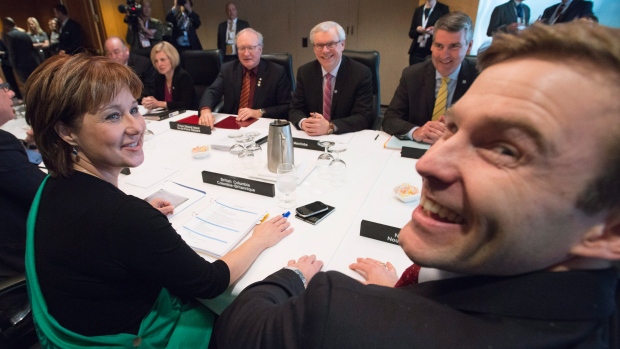
Gallant made the comments in a conference call on Friday before boarding a plane back to New Brunswick after spending the last two days alongside Prime Minister Justin Trudeau and provincial leaders in Vancouver in discussion on a national climate strategy.
The premier has previously said that his government is considering putting a price on carbon, among other ideas, as a way to address greenhouse gas emissions. He reaffirmed that idea on Friday.
“Yes, we’ll still consider it,” Gallant said. “We’re going to strengthen the climate change action plan which means we are considering an array of options and yes, putting a price on carbon would be one of the things we are considering. “But I want to be clear, we’re going to consult with the industry, with the business the community, and with New Brunswickers to see what our further enhancements should look like and if that should include a price on carbon.”
An official statement from the meeting reads that the first ministers have agreed to transition to a low carbon economy with measures including “carbon pricing mechanisms, adapted to each province’s and territory’s specific circumstances.”
Asked what are other “mechanisms” the government could consider outside of a carbon tax or a cap-and-trade system, Gallant suggested an increase in the gas tax.
“There are many ways we can approach this, for example, we can raise the taxes on gas,” Gallant said in French. “That would be a form of carbon tax. So we’ll continue to look at this and we’ll continue to consult with New Brunswickers, industry and others who want to work on climate change.”
Push Back
The federal government has been quietly insisting for weeks that a national carbon price, as promised in the Liberal election platform, will be imposed from above if provinces are unable to agree. But several provinces have since questioned the idea altogether.
Saskatchewan Premier Brad Wall has led the charge against a federally imposed carbon tax, warning of its impact on the economy.
Yukon Premier Darrell Pasloski is also against imposing any additional costs on fossil fuel consumers in Canada’s North, as are his counterparts in the Northwest Territories and Nunavut.
Nova Scotia Premier Stephen McNeil said on Thursday that after spending heavily on hydro-electric transmission, Atlantic Canada has effectively built a carbon price into electricity rates that are the highest in Canada.
“I think Stephen is right,” Gallant said on Friday. “I think all the provinces across the country have done many things to combat climate change already. “In terms of what is happening on the east coast, I can’t speak to Nova Scotia’s policies, but I can speak to New Brunswick’s. You look at NB Power and they have done a great job over the years of ensuring that renewables is a big part of their portfolio.”
He added: “It’s important for New Brunswick’s plan to combat climate change, but it also comes with a cost. Renewables can at times be more expensive than other types of power that are generated from other sources.”
“So you (can) make the argument, obviously, that we are (adding a) price to the ratepayers’ system to ensure that there are renewables.”
But Gallant said that doesn’t mean New Brunswick has done its part. “We have to do more,” he said.
Federal working groups will be set up to assess climate change policy options and another first ministers meeting will be held in the fall where the goal will be to finalize a national strategy.
Reaction
Progressive Conservative MLA Brian Macdonald said on Friday that the provincial shouldn’t move ahead with a carbon tax.
“Absolutely not,” Macdonald said. “The government already has enough of our money, they have already raised every tax and fee across the province, and this carbon tax that is proposed will be another job killer.”
Green party Leader David Coon asked on Friday for Premier Brian Gallant to “publicly share the broad range of measures he has in mind to drive the transition to a low carbon economy in New Brunswick.”
“Like all New Brunswickers, I am eager to see the premier’s plan for making the transition away from fossil fuels to renewable energy and clean technology,” Coon said.
The Green leader wants Gallant to place a fee on carbon that enters the province – specifically NB Power when it imports coal, Irving Oil when it imports oil, and on Enbridge when it imports natural gas.
He estimates the move would generate $164 million per year, revenues the province should then use to fund new green infrastructure such as public transportation, energy efficiency and renewable energy investments.
Energy East
A joint press release issued by the prime minister and the premiers at the conclusion of the Vancouver meetings stated that the first ministers “agreed on the importance and urgency of moving Canada’s resources to market in responsible, timely, predictable and sustainable ways that Canadians trust.”
Gallant said that was important in the context of Energy East and other future energy projects.
“I was very pleased to see all premiers and the prime minister – which obviously includes the premier of Quebec – sign off on the declaration (which includes a statement on moving resources to market),” Gallant said. “I think it is a clear indication that we understand how important developing our natural resources and energy projects responsibly is for the Canadian economy.
“I think it was a step in the right direction.”
l’article par Mathieu Roy-Comeau, Acadie Nouvelle
Le chef du Parti vert n’est pas chaud à l’idée d’une hausse de la taxe sur l’essence. Selon David Coon, la taxe ne sera jamais assez élevée pour véritablement changer les habitudes de conduite des automobilistes. Le député vert suggère plutôt un «frais sur le carbone» imposé directement aux grandes entreprises qui importent du pétrole ou du gaz dans la province.
Une hausse de la taxe sur l’essence pourrait servir de méthode pour mettre un prix sur le carbone et réduire les émissions de gaz à effet de serre du Nouveau-Brunswick, selon Brian Gallant.
La tarification du carbone n’est qu’une seule des avenues envisagées par la province pour combattre les changements climatiques, assure le premier ministre.
Mais cette tarification ne passe pas nécessairement par une taxe sur le carbone ou un marché du carbone, prévient M. Gallant.
Pour la première fois, le premier ministre laisse entendre qu’il pourrait aussi hausser la taxe sur l’essence à titre de mesure de tarification du carbone.
«Il faut avoir (…) un mécanisme pour mettre un genre de prix sur le carbone, mais ça n’a pas nécessairement besoin d’être une bourse sur le carbone ou peu importe les autres options», résume M. Gallant.
«Il peut y avoir d’autres sortes (de mécanisme) qui feraient les mêmes efforts.»
«Par exemple, lorsque l’on augmente les taxes sur l’essence comme nous l’avons déjà fait au Nouveau-Brunswick, c’est un genre de tarification du carbone», suggère-t-il.
Brian Gallant était à Vancouver pour la réunion provinciale-fédérale des premiers ministres sur les changements climatiques.
Le premier ministre Justin Trudeau et ses homologues des provinces et des territoires se sont notamment entendus pour mettre sur pied un groupe de travail sur «les mécanismes d’instauration d’un prix sur le carbone».
La Colombie-Britannique et l’Alberta ont déjà adoptées une taxe sur le carbone alors que le Québec et l’Ontario ont choisi de participer à un marché d’échange de droits d’émissions.
En campagne électorale, Justin Trudeau a promis de collaborer avec les provinces pour «mettre un prix sur le carbone», mais plusieurs provinces, dont la Saskatchewan, se font tirer l’oreille.
M. Trudeau éviter de préciser jeudi s’il imposait un prix sur le carbone aux provinces qui n’adopteront pas leur propre mode de tarification.
Les premiers ministres se sont également engagés à Vancouver à «assurer une transition vers une économie sobre en carbone en adoptant une vaste gamme de mesures», dont des «mécanismes d’instauration d’un prix sur le carbone»
Ces mécanismes devront cependant être «adaptés aux circonstances de chaque province».
Brian Gallant indique ne pas sentir de «pression politique» de la part du fédéral concernant la tarification du carbone, mais plutôt une urgence d’agir généralisée pour relever «le plus gros défi humanitaire auquel nous faisons face».
À Fredericton, l’opposition officielle est d’avis que le gouvernement ne doit «absolument pas» aller de l’avant avec une taxe sur le carbone.
«Je ne crois pas que donner une autre occasion à ce gouvernement pour prendre l’argent de la population et la mettre où il le souhaite par bénéficier aux gens du Nouveau-Brunswick», mentionne le député progressiste-conservateur Brian Macdonald.
Le chef du Parti vert n’est pas chaud à l’idée d’une hausse de la taxe sur l’essence. Selon David Coon, la taxe ne sera jamais assez élevée pour véritablement changer les habitudes de conduite des automobilistes.
Le député vert suggère plutôt un «frais sur le carbone» imposé directement aux grandes entreprises qui importent du pétrole ou du gaz dans la province.
«À moyen ou long terme (les industries) répondent de façon plus directe à ce genre de signaux sur les prix», assure-t-il.
Brian Gallant a l’intention de présenter une version révisée du Plan d’action provincial sur les changements climatiques avant la fin de l’année.