Article by Jacques Poitras
Photo by Jacques Poitras
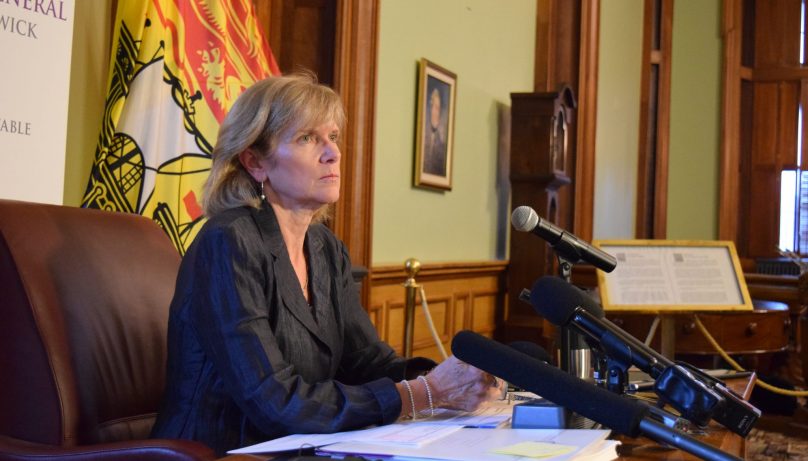
A government-hired consulting firm was paid millions of dollars by New Brunswick taxpayers, despite not saving nearly as much money as promised, according to the province’s auditor general.
Ernst & Young played a role in setting the terms of part of the contract the firm later bid on, which Kim MacPherson calls a conflict of interest.
The consultants began their work at the Department of Social Development under the previous Progressive Conservative government, but they continued to bill taxpayers after the Liberals took office in 2014 and after staff turnover in the department — indications of a « culture of complacency, » MacPherson says in her report.
The original PC contract was for two years and Liberals could have used the 2015 extension to tighten its terms, she says, but they didn’t.
MacPherson said the consultants were still working with the Department of Social Development as of February of this year.
Questions how work monitored
« The consultant was paid regardless of whether or not government implemented and achieved the savings solutions identified. »
The facts show « a very troubling disregard » for how government contracts should be signed and monitored, the report says.
Gallant government won’t automatically extend Red Cross contract
-$11M wheelchair contract awarded without cabinet approval
-Liberal cabinet minister Serge Rousselle said in the wake of the report that the government would implement MacPherson’s recommendations.
He said the Liberals allowed the contract to continue in 2015 because « all that work had been done, so the department decided at this stage, it was better to finish the work with this consulting firm. »
Included in Ernst & Young’s billings was $1.9 million for two initiatives that were never implemented.
The consultants also earned a $97,000 « performance fee » for awarding a wheelchair-maintenance contract to the Canadian Red Cross — a decision that created headaches for many disabled people on low incomes.
Much less saved than expected
That contract was supposed to save taxpayers $647,000 but the savings were only $116,500.
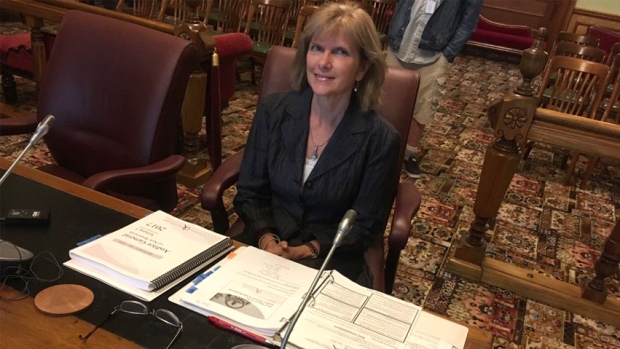
MacPherson presented the first volume of her annual report to a committee of MLAs at the legislature Tuesday morning.
The goal of the Ernst & Young work was to save $47 million, but by June 2016, the government said only $10 million had been saved. MacPherson said she couldn’t be sure even that amount was accurate.
The government relied on the consultants to evaluate their own performance. They were paid for « anticipated » savings, not real savings, the auditor general says.
Benefits not clear to auditor
« The actual benefit to the Department of the $13 million consultant payments remains unclear at best, » MacPherson says in her report.
According to the audit, the Department of Social Development used an « urgent/emergency » exemption to award Ernst & Young the first two phases of the contract in the first half of 2013, when the PC government of David Alward was still in office.
The « emergency » exemption allowed the firm to be hired without a tender.
But that exemption was created to allow fast action in situations such as floods or the failure of a heating system in a school during the winter, MacPherson says, not « to achieve aggressive budget reduction targets » — the reason cited in 2013.
Conflict-of-interest concerns
Service New Brunswick staff warned Social Development the « emergency » exemption couldn’t be used indefinitely.
« We feel that the longer one company is engaged under exemption, the more biased our evaluation becomes and could be challenged as an unfair process by the other qualified companies, » the audit quotes Service New Brunswick staff telling the department at the time.
But the agency approved the contract anyway.
Service New Brunswick also warned that Ernst & Young would be in a conflict of interest because the consultants were already working with the department and were involved in drafting a tender for the next phase of the contract that they would bid on.
This « highly and inappropriately » created an advantage for the consultants, MacPherson writes, but the department went ahead.
Not the first time
Ernst & Young was awarded the $12.25 million phase three contract after three other bidders were disqualified, and it appeared to know it had landed the bid before Service New Brunswick signed off.
Similar issues came to light in MacPherson’s 2012 report that showed consultants on an e-health contract had influence over whether they or their competitors were chosen for additional work.
She said Tuesday that five years later, it was « a good question » why the rules had not been changed to prevent that from happening again.
Rousselle said « there are certainly a lot of questions » about how the contract was awarded, « and I strongly invite you to go and ask those questions to Mr. Higgs. »
Higgs was minister
PC Leader Blaine Higgs was the finance minister at the time and was overseeing the government’s process-improvement initiative.
Higgs wasn’t available Tuesday but first-term PC MLA Ernie Steeves said he would ask former PC ministers who were around in 2013 what happened.
« I would say from the AG’s report that there were things that obviously could have been done better, » he said. « Those people made decisions that they thought were the best for New Brunswick at the time. Every government does. »
The province also paid $700,000 more than what the Ernst & Young contract’s purchase order allowed, MacPherson’s report says. The consultants also billed $600,000 in travel expenses.
Complaints about Red Cross deal
The Red Cross contract, signed in August 2014, was the subject of complaints by several disabled New Brunswickers last year who told CBC News they had to turn to charities for help because the Red Cross was taking too long to provide services.
Those services included the provision and maintenance of wheelchairs and other equipment to help them be more mobile.
The New Brunswick Association of Occupational Therapists warned in December 2014 that the Red Cross lacked the ability to take over those services.
Service New Brunswick said last year that the contract was awarded « in a fair and consistent manner, not only based on pricing, but on all technical and service related requirements. »
No automatic renewal
But last December the Liberal government said it would not automatically renew the Red Cross contract and would invite new bidders.
MacPherson’s audit says the Red Cross contract was one cost-saving initiative developed by Ernst & Young. She said it created an « increased risk of inadequate service delivery » and fell short of its anticipated savings.
« Given that Social Development delivers social programs to those who are the most vulnerable in New Brunswick, you would have expected that they would assess, in implementing these changes, the impact on the client, » MacPherson said, « and we found that they did not do that. »
Article : Mathieu Roy-Comeau
Photo : Mathieu Roy-Comeau
Une firme d’experts-conseils a été payée 13 millions $ par le gouvernement du Nouveau-Brunswick selon des «pratiques douteuses» et dans le «mépris» des règles en vigueur pour réaliser à peine 10 millions $ d’économies.
La vérificatrice générale du Nouveau-Brunswick, Kim MacPherson, lève le voile dans son plus récent rapport sur la «culture de complaisance» en matière d’attribution de contrats qui règne à son avis au ministère du Développement social, autant sous les libéraux que sous les progressistes-conservateurs.
Au coeur de l’affaire se trouvent des services de consultations obtenus sans appel d’offres auprès du cabinet Ernst & Young en 2013 dans le but de générer des économies de 47 millions $ au sein du ministère du Développement social.
Puisque la firme a été payée selon les résultats anticipés plutôt qu’en fonction des résultats réels, Fredericton a fini par lui verser 13 millions $ pour des économies évaluées à 10 millions $ par le ministère.
Ces économies pourraient cependant s’avérer en dessous ce cette somme puisque la vérificatrice générale affirme ne «pas avoir trouvé suffisamment de données pertinentes» pour corroborer les calculs du ministère.
La province a notamment versé 1,3 million $ à Ernst & Young pour des extras qui auraient dû faire partie du contrat, avance Mme MacPherson.
Fredericton a également accordé 646 000$ au cabinet d’experts-conseils pour des frais de déplacement, et ce, sans réclamer de factures ou de pièces justificatives.
Selon Kim MacPherson, le ministère du Développement social s’est servi de «pratiques douteuses» et a fait preuve d’un «mépris préoccupant» des règlements en choisissant Ernst & Young pour effectuer le travail.
Afin d’éviter d’aller en appel d’offres pour la première et la deuxième phase du projet, le ministère a évoqué à l’époque l’urgence de la situation, même si l’affaire n’avait absolument rien d’urgent selon la vérificatrice générale.
«De nos jours, (les réductions budgétaires) sont du travail routinier dans tous les ministères», affirme-t-elle.
Le contrat conclu avec Ernst & Young était «mal structuré» et n’avait pas «d’objectifs clairs», constate MacPherson. Le ministère du Développement social s’est tout simplement avéré «incapable de gérer efficacement le contrat», dit-elle.
La firme a notamment été appelée à évaluer elle-même la qualité de son travail. Elle a aussi participé à la préparation d’un appel d’offres qu’elle a remporté par la suite pour effectuer la troisième phase du projet.
«Nous estimons que cette situation a augmenté la possibilité d’un conflit d’intérêts et d’influence indue de la part des experts-conseils pendant le processus d’appel d’offres (…) et peut avoir mené à un approvisionnement inéquitable», écrit la vérificatrice dans son rapport.
Service NB, l’agence responsable des appels d’offres au sein de la fonction publique, a mis en garde le ministère du Développement social à plus d’une reprise contre ces pratiques non orthodoxes avant de sanctionner malgré tout ces actions, constate-t-elle.
Kim MacPherson a été incapable d’obtenir des explications sur ces manquements aux règlements de la part des responsables du ministère du Développement social qui ont souligné les nombreux changements au sein du personnel du ministère depuis 2013 pour éviter de répondre à ses questions.
«Malgré le roulement du personnel, le ministère devrait être capable de rendre des comptes», insiste Mme MacPherson.
«Je suis préoccupé du fait qu’il n’y a aucune conséquence pour le ministère.»
Les libéraux et les conservateurs sont mis en cause
Les deux partis politiques qui se sont partagé le pouvoir depuis 2013 sont éclaboussés par le rapport de la vérificatrice générale.
Chacune des phases du projet a été accordée à Ernst & Young alors que les progressistes-conservateurs étaient au pouvoir.
Le gouvernement libéral du premier ministre Brian Gallant a cependant choisi de prolonger d’une année le contrat avec le groupe d’experts-conseils en 2015.
C’est le ministre de l’Environnement et des Gouvernements locaux, Serge Rousselle, qui a répondu aux questions des médias au nom du gouvernement, mardi.
Selon lui, le travail d’Ernst & Young a permis de générer 14 millions $ en économie l’an dernier en plus des 10 millions $ déjà comptabilisés par le ministère du Développement social.
Le gouvernement a choisi de prolonger le contrat de la firme malgré les «anomalies» en raison de tout le travail qui avait déjà été effectué, a expliqué M. Rousselle.
Le ministre a promis que chacune des recommandations de la vérificatrice générale serait mise en oeuvre.
Serge Rousselle a toutefois refusé de dire si des fonctionnaires pourraient être punis pour leur rôle dans cette affaire.
C’est le ministre Rousselle qui a identifié la firme Ernst & Young que la vérificatrice générale a refusé de nommer dans son rapport et dans ses réponses aux questions des médias.
Le porte-parole des progressistes-conservateurs en matière de développement social, Ernie Steeves, a été incapable d’expliquer les décisions de son parti à l’époque où il était au pouvoir.
Le député a cependant promis d’obtenir des réponses auprès de ses collègues et anciens ministres et de les partager avec le public.
«Nous allons en discuter au sein du caucus», a-t-il dit.
«(Les anciens ministres conservateurs) ont pris les décisions qu’ils pensaient les meilleures pour le Nouveau-Brunswick à l’époque. Tous les gouvernements font ça. Et puis la vérificatrice générale corrige les mauvaises décisions», a résumé M. Steeves.
«Ces recommandations sont solides et elles devraient être mises en oeuvre», a dit celui qui n’était pas encore député à l’époque en 2013.
Ernst & Young n’a pas répondu à notre demande de commentaires.